
- District Gazetteer
- Archive Election
- Citizen Services
- Schemes
-
Media Gallery
- Photo Gallery
- Video Gallery
- Forms
- RTI
- REDCROSS
![]() | ||||
Vishal Singh IAS, Collector-cum-Chairman , IRCS, Keonjhar |
Mandardhar Mahalik OAS(S),Vice Chairman, IRCS,Keonjhar |
Dharitri Rout, Non Official Vice Chairman,IRCS,Keonjhar | ARKHAN, Jt. Secretary, IRCS,Keonjhar | |
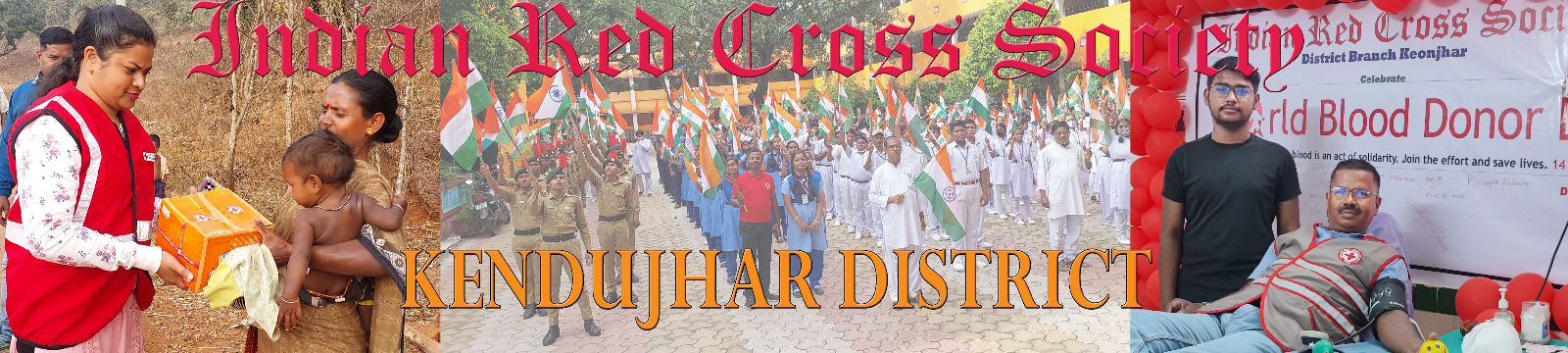
INDIAN RED CROSS SOCIETY, DIST.BRANCH,KEONJHAR ABOUT :- The Indian Red Cross Society is functioning at Keonjhar Since 1951. The Indian Red Cross Society, the State Society and the District Branches are all autonomous bodies Operating with the Common Objective of mitigating human suffering ang giving relief to distressed persons. Disaster relief is an important item of Red Cross Programme. The Day-to-day management of the Programme of the District Branch is looked after by Working Committee of Which the Collector is the ex officio Chairman. Funds of the District Branch are Collected by enrolment of members & raising of Donations. In 2024-25 the Society has 45Patrons,128 VicePatrons,2681 life Members.The Collector & District Magistrate Vishal Singh IAS is The Chairman Of the District Branch, The Addl District Magistrate Mandardhar Mahalik OAS(S) is The Vice Chairman, Smt Dharitri Rout is Non Official Vice Chairman.District Emergency Officer Bikash Chandra Sahu OAS Is Secretary Of The District Branch, Mr.A.R. Khan is the Joint Secretary Of the District Branch. Executive Committee. Junior Red Cross Committee, Youth Red Cross Committee,Finance Committee, Health Committee. |
The Indian Red Cross is a voluntary humanitarian organization having a network of over 1200 branches throughout the country, providing relief in times of disasters/emergencies and promotes health & care of the vulnerable people and communities. It is a leading member of the largest independent humanitarian organization in the world, the International Red Cross & Red Crescent Movement. The movement has three main components, the International Committee of Red Cross (ICRC), National Societies and International Federation of Red Cross and Red Crescent Societies. The Mission of the Indian Red Cross is to inspire, encourage and initiate at all times all forms of humanitarian activities so that human suffering can be minimized and even prevented and thus contribute to creating more congenial climate for peace.
History of Red Cross and Red Crescent MovementYoung Swiss businessman, Jean Henry Dunant was appalled by the condition of the wounded soldiers he happened to see in the battle field of Solferino, Italy in 1859 during the Franco - Austrian war. He arranged relief services with the help of the local community immediately. He wrote the book 'Memory of Solferino' suggesting that a neutral organization be established to aid the wounded soldiers in times of war. Just a year after the release of this book, an international conference was convened in Geneva to consider the suggestions of Henry Dunant and thus the Red Cross Movement was born. International Red Cross Movement was established by Geneva Convention of 1864. The name and the emblem of the movement are derived from the reversal of the Swiss national flag, to honor the country in which Red Cross was found. Origin of Indian Red Cross Society During the first world war in 1914, India had no organization for relief services to the affected soldiers, except a branch of the St. John Ambulance Association and by a Joint Committee of the British Red Cross. Later, a branch of the same Committee was started to undertake the much-needed relief services in collaboration with the St. John Ambulance Association in aid of the soldiers as well as civilian sufferers of the horrors of that great war. A bill to constitute the Indian Red Cross Society, Independent of the British Red Cross, was introduced in the Indian Legislative Council on 3rd March 1920 by Sir Claude Hill, member of the Viceroy's Executive Council who was also Chairman of the Joint war Committee in India. The Bill was passed on 17th March 1920 and became Act XV of 1920 with the assent of the Governor General on the 20th March 1920 . On 7th June 1920, fifty members were formally nominated to constitute the Indian Red Cross Society and the first Managing Body was elected from among them with Sir Malcolm Hailey as Chairman. Indian Red Cross Society is a member of the International Federation of Red Cross and Red Crescent Movement. Relations between the IRCS and the India Delegation of the Federation are strong. Indian Red Cross Society has partnership with National Red Cross and Red Crescent Societies, St.John Ambulance, International Federation of Red Cross and Red Crescent Movement (IFRC), International Committee of the Red Cross (ICRC ), Multinational firms. Individuals and others in supporting IRCS activities. It also coordinates with Indian Government and other agencies ( UNDP, WHO etc ) Red Cross Emblem Red Cross on a white background, is the Emblem of Red Cross, recognized in 1864 as the distinctive sign for medical relief teams on the battle field. In the Russo-Turkish war the Ottoman empire used a Red Crescent in place of the Red Cross. Egypt too opted for the Red Crescent while Persia chose a Red Lion on a white background. These symbols were written and accepted into the 1929 Geneva Conventions. The IRCS adopted RED CROSS as its emblem. The National Society make use of the emblem as an indicative device in peacetime and during armed conflicts within the limits stipulated in national legislation, the regulations and its statutes only for activities consistent with the principles set out by International Federation of the Red Cross and Red Crescent. During the General Assembly and the council of Delegates in November 2005 at Geneva, Red Crystal has been adopted as another emblem for the Red Cross Red Crescent movement. Seven Fundamental Principles of Red Cross 1. Humanity:The International Red Cross and Red Crescent Movement, born of a desire to bring assistance without discrimination to the wounded on the battlefield, endeavors, in its international and national capacity, to prevent and alleviate human suffering wherever it may be found. Its purpose is to protect life and health and to ensure respect for the human being. It promotes mutual understanding, friendship, cooperation and lasting peace amongst all peoples. 2. Impartiality:It makes no discrimination as to nationally, race, religious beliefs, class or political opinions. It endeavours to relieve the suffering of individuals, being solely by their needs, and to give priority to the most urgent cases of distress. 3. Neutrality:In orders to enjoy the confidence of all, the Movement may not take sides in hostilities or engage in controversies of a political, racial, religious or ideological nature. 4. Independence:The Movement is independent. The National Societies, while auxiliaries in the humanitarian services of their governments and subject to the laws of their respective countries, must always maintain their autonomy so that they may be able at all times to act in accordance with the principles of the Movement. 5. Voluntary Service:It is voluntary relief movement not prompted in any manner by desire for gain. 6. Unity: There can be only one Red Cross Or Red Crescent in any one country. It must be open to all. It must carry on its humanitarian work throughout its territory. 7. Universality:The International Red Cross and Red Crescent Movement, in which all societies have equal status and share equal responsibilities and duties in helping each other, is worldwide. IRCS Branch Rules Rules for State/UT/District Branches of the Indian Red Cross Society made under Section 5 of the Indian Red Cross Society Act, 1920 (as Amended by Act No. 22 of 1956 and the Adaptation of Laws (No.4) Order of 1957 and the Act No.14 of 1992) have been approved by the President of IRCS (Hon’ble President of India). The Rules deal with mission and objectives of the Red Cross, legal provisions of the branches, membership & fundraising rules and governance and management of the State/UT/District Branches. Click here to download Rules for State/UT/District Branches notified on 15 December, 2017 [PDF] Click here to download Uniform Guidelines for Statutory Auditors of State/UT Branches Get Involved Membership Individual/institutions enrolling themselves in different grade of memberships by subscribing the membership fee as follows:-
All member is associated with the Red Cross world over. The Patron membership certificates issued by the national Headquarters of the Indian Red Cross Society are signed by Honourable President of India, in his capacity as President of the Indian Red Cross Society. Vice – Patron, Life Member and Life Associate membership certificates are signed by the Chairman and Secretary General of the society. Indian Red Cross Society has its branches in every state, union territory and district level. Membership is obtained by enrolling in the respective state/district branch of the India Red Cross society to which one belongs. On becoming Patron, Vice-Patron and Life member of the India Red Cross Society who gets the opportunity to be invited, on the recommendations of the enrolling state/district Branch, for attending the Annual General Meeting of the society. The Annual General Meeting is presided by Honourable President of India. On becoming member in any grade of membership, the individual helps in rendering Red Cross a noble cause to serve the most vulnerable and thereby reaching to the needy, through Red Cross.
Volunteering has been at the very heart of the Red Cross since its inception in 1920.Volunteers are the backbone of all Indian Red Cross activities, helping branches to run successful programmes and assisting millions of vulnerable people in need. IRCS rewards and recognizes volunteers whenever possible and provides appropriate personal development opportunities. IRCS recruits’ volunteers irrespective of their race, ethnicity, sex, religious belief, age, and disability or membership. All volunteers are entitled to become a Member of Indian Red Cross Society; can have appropriate training to be able to undertake the agreed tasks or role; and accept or refuse any task or role in accordance with code of ethics or fundamentals of voluntary service. If one wants to become a Volunteer, Please contact nearest State / UT / District Red Cross (State Branch addresses - North zone, South zone, East zone, West zone) A substantial portion of the membership of Indian Red Cross Society is made up of young people. Young volunteers can make a significant contribution to meeting the needs of the most vulnerable people within their local communities through Red Cross youth programme. When can we start? At the beginning of the school /college term is a good time to start programmes, but you can contact your local branch at any time for more information. Ask your counsellor/program officer (teachers/lecturers) and contact District Red Branch /State Red Cross Branch if you do not have a Red Cross wing in your school/colleges. Youth As Agents of Behavioural Change Guidelines for Junior and Youth Red Cross Origin InOdisha The Indian Red Cross Society was established in 1920 through an Act of the Parliament,
OUR ACTIVITIES TOWARDS HUMANITY | ||||||||||||||||||